
Bringing classical education into any classroom
Small steps, inspired by ancient wisdom

On June 6, 2026 I was happy to visit Atlanta where I gave a couple of presentations at a conference for practicing teachers sponsored by Freedom in Education (where I serve on the advisory board) and researchED. Last week I posted an article based on my first talk about classical education and metacogniton. Below is a version of my second talk on practical steps any teacher can make to bring elements of classical learning into your classroom.
I have a long-standing interest in the revival of classical education, an interest that took on a tangible form when I became part of the founding team of the Chesterton Academy of Bowling Green, a new Catholic classical high school opening in August.
Many of my educator friends still working in public schools have also taken an interest in classical learning, and a few of them have reached out to ask me if there are ways to bring classical ideas and techniques into secular, public classrooms. I believe there are.
I believe that classical education is not just for the elite, but rather is the birthright of every American student, and should be readily available to every family, no matter the student’s educational background or learning profile. And I believe we can begin with small steps, in any classroom.
What follows is not a to-do list. It is more of an invitation. I am not asking you to redesign your school or throw out your curriculum. I am asking you to consider three or four small, concrete moves, moves that teachers have been making for 2,500 years, that can quietly transform what happens in your classroom.
The forgotten mission
I want to start with the reason most of us got into this business in the first place.
You likely went into teaching because you believed it mattered, not just for test scores, but for the kind of people your students would become. And then the system handed you a pacing guide and insisted you start looking at students as the sum of their scores.
Not that there is anything wrong with test scores. I’m a firm believer in testing and accountability. We need clear, objective tools for knowing whether our students have mastered the content and skills we are expected to teach them. But those outcome metrics should be in service to larger purpose to schooling, and I want to invite you to reconnect with that purpose.
Before the 20th century, every serious educational tradition — Greek, Roman, medieval, Renaissance, even into the era of the American founding — understood that schools existed primarily to form character. Education was about the formation of the human person into a particular mold: that of virtue. Human beings need to be formed. We are not naturally virtuous. Forming virtuous adults was the whole point of education. The transmission of content was always in service of that larger goal.
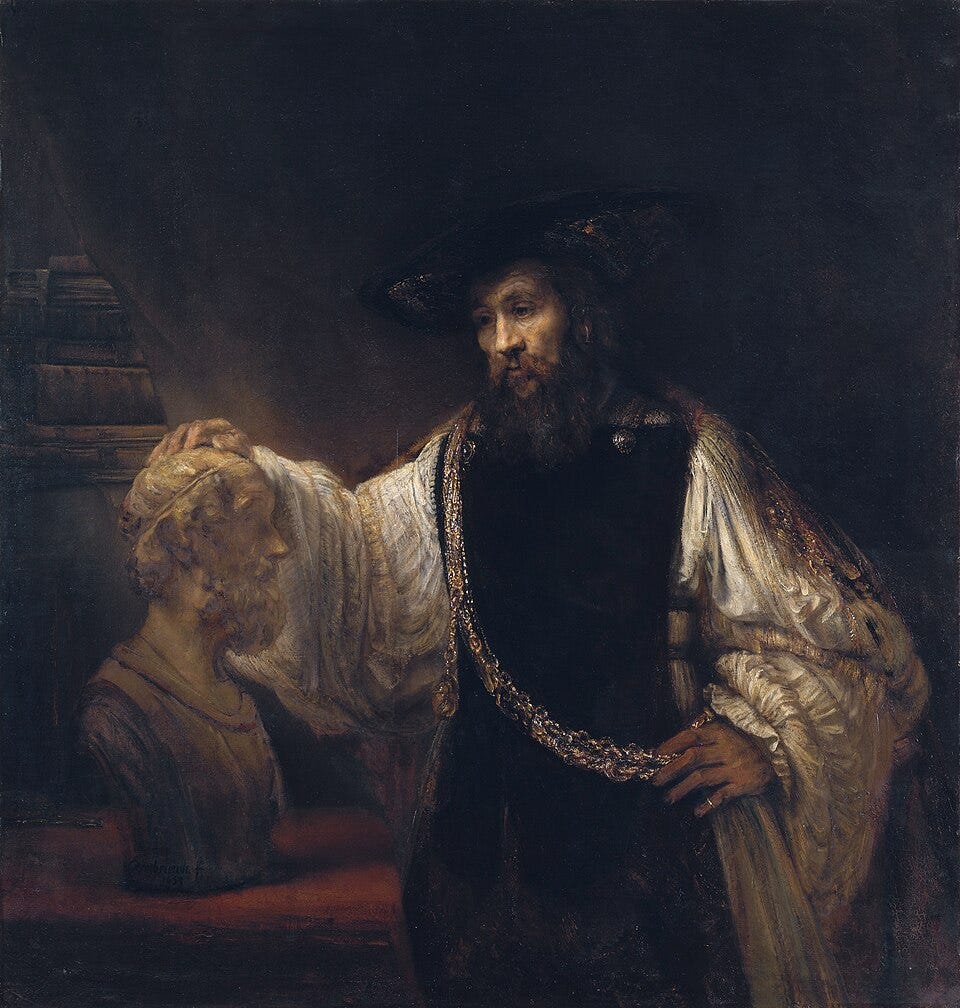
Starting in the 19th century and accelerating through the 20th, as schooling became compulsory and mass-scale, the formative purpose was gradually displaced by measurable outcomes: test scores, graduation rates, college readiness. These things matter. But they are not the same thing as the formation of a human being.
Most teachers did not enter the profession to raise test scores. They entered because they believed that what happened in their classroom shaped the people those students were becoming. That instinct is correct. And it deserves to be trusted.
Formation, not just information
I want to be careful with the word virtue, because it may feel either old-fashioned or religious to some readers. But what the classical tradition means by virtue is not mysterious: honesty, courage, self-control, generosity, justice. These are not controversial. Every teacher cares about them. Every parent wants their child to develop them. The classical tradition simply takes them seriously as the organizing purpose of education rather than a sidebar to the real work.
So here is the practical question I want to put before you: Before you change a single lesson plan, ask yourself, what virtues am I trying to form in my students this semester? What would it look like if that question guided my teaching decisions?
This is not about adding a character education program. It is about a shift in orientation. Teaching as if the formation of the human person matters — because it does.
Evironment is pedagogy
The classical tradition understood something modern education largely ignores: the environment of learning is itself a form of instruction. How the teacher carries herself, how the room is arranged, how students are addressed, these send constant signals about what kind of work we believe we are doing here.
I learned this early in my own teaching career. On days when I came to school dressed more casually, I could sense its effect on my students’ attitudes and behavior. When I dressed more professionally, I could feel a shift in their seriousness about the task at hand.
For a while I experimented with calling students by their last names — Mr. and Ms. They found this amusing, sometimes off-putting. But it was a way of saying: I take you seriously as a learner responsible for your own learning. We developed small rituals for how we entered and left the classroom, how papers were passed in. These conventions are not about formality for its own sake. They say: We are about something important here.
The cumulative effect is real. When students walk into a room that is ordered, where the teacher is clearly prepared and present, where they are addressed with some dignity — they adjust. Not immediately, not uniformly, but over time. The culture shapes the person.
One of the ancient ways of understanding this process is what St. Augustine called ordo amoris, or the right ordering of our affections. As human beings we have many passions, the old fasioned way of thinking about emotions or attachments. These emotions and attachments are not necessarily bad. But in the unformed person our passions tend to be disordered or, at best, misordered. Education (formation), then, is about ordering our affections properly. And an ordered external environment helps us order to our interior life as well.
A few other low-cost, high-signal practices worth considering:
How you open class. A brief moment of stillness, a question on the board, a quotation to consider — the opening of class sets the tone for everything that follows.
What is on your walls. Are there motivational posters, or are there maps, timelines, portraits of historical figures, quotations from serious thinkers? The walls teach too.
How you respond to shallow answers. Not accepting “I don’t know” without a follow-up, not rewarding volume over substance, asking for more; this models the intellectual culture you want.
The classical insight here is that virtue is formed by habituation: by repeated exposure to excellent models and ordered environments. You cannot talk students into becoming thoughtful people. You have to surround them with thoughtfulness.
I know some of you work in genuinely difficult school environments where this can feel unrealistic. I spent four years as director of an alternative high school for at-risk students, some of the toughest kids you will ever meet. I was still able to use some of these strategies to real effect. It often starts with just one thing. One change in how you begin class. One shift in how you address students. Small steps.
Read more, and read better
The classical tradition has always been grounded in reading primary sources. Not summaries of what great thinkers said, but the thinkers themselves. When you read an original voice, you encounter a mind, not a digest of information. You have to do the work of understanding rather than receiving a pre-packaged interpretation.
Most public school students are not reading much, and many resist it when asked. This is a real constraint, but not an excuse. But the solution is not to stop assigning reading. It is to be strategic about what you assign and how you frame it.
The entry point is to start shorter. One paragraph of a primary source is better than zero. A single letter, one speech excerpt, one journal entry from a historical figure, these are achievable and genuinely transformative. Here is why original sources specifically:
They are more interesting than textbooks. Real people writing about real stakes are more compelling than third-person summaries.
They require active inference. The student has to figure out what the author meant, what they assumed, what they left out. That is metacognition made necessary.
They challenge our assumptions. Reading voices from other times and places forces students to see that things could be otherwise, a profoundly important intellectual habit.
For resistant readers, a few practical moves help. Pairing reading with Socratic discussion works well: students who know they will have to defend their interpretation in front of peers tend to read more carefully. Also, read aloud together sometimes. The classical tradition included oral reading for good reason, because the voice makes the text alive in a way silent reading does not always achieve. And give students a purpose before they read: not “read this and answer the questions,” but “read this looking for evidence of courage” or “find the moment where the author’s argument breaks down.”
There is also value in telling students why you are doing this differently than they are used to. The move of explaining your pedagogy is itself a classical practice. It names the purpose.
The Socratic classroom
If you have read Plato’s dialogues, you have seen Socrates doing his thing: teaching almost entirely through a series of ever-more-deeply probing questions. But there is often some misunderstanding about what this looks like in a conventional classroom.
A Socratic discussion is not a classroom free-for-all where students share opinions. It is a disciplined form of inquiry in which the teacher’s questions push students toward greater precision, deeper justification, and honest confrontation with what they do not yet know.
The cognitive mechanism is this: the teacher’s probing questions externalize the inner voice of good thinking. Over time, students internalize those questions and begin to ask them of themselves. This is metacognitive formation, not just a discussion technique.
The Socratic method also requires more of the teacher, not less. You have to have done the intellectual work: read the text, thought about it seriously, anticipated the moves students might make. It is not facilitation; it is engaged intellectual leadership.
For teachers new to this, some practical scaffolding helps:
Start with a text, not a topic. “What do you think about justice?” is too open. “What does Atticus Finch’s defense of Tom Robinson reveal about the relationship between law and justice?” is workable.
Use a simple structure. Open question → student response → probing follow-up → another student response → synthesis. No complicated protocol required.
Establish norms explicitly. We are not looking for the right answer; we are looking for the best-supported answer. We are allowed to change our minds. We are expected to listen before we respond.
Start with 15 to 20 minutes, not a full period. A focused short discussion is more valuable than an unfocused long one.
And if a full Socratic seminar still feels unreachable, here is the minimum viable move: one genuine follow-up question per discussion (e.g., “Why do you think that?”) Say it seriously, with a pause, and with a real expectation of a real answer. That is already a classical practice. Do it every day and watch the culture of your classroom shift.
One more thing worth noting: the Socratic method is one of the most effective classroom management tools available. Students who are genuinely engaged in thinking are neither disengaged nor disruptive. Intellectual engagement and behavioral order reinforce each other.
Virtue as curriculum organizer
The four cardinal virtues (prudence, fortitude, temperance, and justice) are ancient ideas of what it means to live a good human life. They appear across cultures and traditions, well beyond their familiar religious contexts. And they offer a powerful lens through which to teach virtually any subject.
In history, you could organize an entire course around the question: What does this material reveal about what it means to live well? Lincoln and fortitude. The fall of Rome and temperance. The American founders and prudence. The civil rights movement and justice. Every historical figure becomes a case study not just in what happened, but in what kind of person it required. That is a far more engaging and memorable frame than chronology alone.
In literature, the connection is almost too obvious. Every great novel asks what it means to live well and what happens when we don’t. In science, there is honesty in inquiry and the courage to revise one’s conclusions in the face of evidence. In mathematics, patience and precision. Every subject has a virtue dimension.
So pick one unit this semester. Ask yourself: What virtue is most at stake in this material? Design two or three discussion questions around that virtue. See what happens to the quality of student thinking.
When students understand that what they are learning connects to the question of who they are becoming, motivation changes. Content that seemed abstract becomes personally significant. I am not going to pretend this is easy. It requires genuine intellectual work from the teacher to make these connections authentically rather than formulaically. But even a clumsy first attempt is better than never asking the question.
Find your people
The classical tradition understood that education is a community practice, not a solo performance. Teachers need to be formed themselves. We all need to be challenged, encouraged, held accountable, in the same way we seek to form our students.
Trying to swim against the current of a conventional school culture is exhausting when you are doing it alone. Having even one colleague who shares the vision changes everything. You can compare notes, share resources, debrief after experiments, and remind each other why you are doing this.
The ask is small: you do not need a movement. You need one person. A colleague willing to try Socratic discussion and then talk with you about what happened. A friend who will assign a primary source alongside their students and compare notes. Over time, a small community of practice can shift a school’s culture more effectively than any top-down initiative. This is how classical education has always spread; not through mandates, but through the contagion of genuine enthusiasm.
The question that remains
Here is what I want to leave you with.
You already believe this. You went into teaching because you believed it mattered for who your students were becoming. This talk has simply tried to give that instinct a name, a tradition, and a few practical tools.
The classical tradition does not ask you to rebuild your school. It asks you to bring a certain quality of intention to what you are already doing.
What would it look like if you taught as if your students’ souls mattered?
That is not a rhetorical question. It is a practical one. And every teacher reading this already knows what the beginning of an answer looks like.
Related posts:
Excellent and wise, as usual. Education will form character, no matter what. The current curriculum forms student's who think that they have a right to express their opinion no matter what and receive affirmation while entering a faux meritocracy based on 'objective measures.'. The four cardinal virtues work very differently.