
Aristotle's Classroom
The ancient origins of modern learning science

On June 6, 2026 I was happy to visit Atlanta where I gave a couple of presentations at a conference for practicing teachers sponsored by Freedom in Education (where I serve on the advisory board) and researchED. Below is a version of my first talk. I’ll post the second one in coming weeks.
A physician friend of mine has been talking to me almost incessantly for the past year about metacognition.
He’s a parent at the Chesterton Academy of Bowling Green, the Catholic classical high school I’m helping open this August, and he’s convinced we need to be explicitly teaching students how to think about their own thinking. I’ve heard his pitch many times now. And somewhere along the way, I started actually listening.
Not because the modern research on metacognition isn’t compelling. Metacognition consistently ranks among the highest-impact interventions in learning science. But what struck me, as someone who has spent the better part of thirty years in K-12 education, is how thin most of the professional development on this topic tends to be: a handful of disconnected strategies, delivered without any underlying philosophy for why they work or how they belong together.
That physician-parent’s persistence, though, sent me back to the classical tradition I’ve been studying for the past decade, and which will be the curricular heart and soul of the Chesterton Academy of Bowling Green.
And what I found there surprised even me. The challenge of teaching students to think well is not a new problem. Some of the most compelling answers were worked out a very long time ago.
Not “Critical Thinking” — Intellectual Virtue
A few months ago, Martin Cothron, my fellow Kentuckian and founder of Memoria Press, one of the great classical curriculum publishers, made an observation on X that stuck with me. He suggested that what we call “critical thinking skills” in K-12 education is really what Aristotle called intellectual virtues.
That’s a useful insight. But I think it needs some refining.
Aristotle distinguished between two kinds of virtues: intellectual and moral. Moral virtues (like courage, justice, temperance) arise through habit and practice. You don’t become courageous by memorizing the definition of courage; you become courageous by repeatedly putting yourself in situations that require courage until it becomes part of who you are.
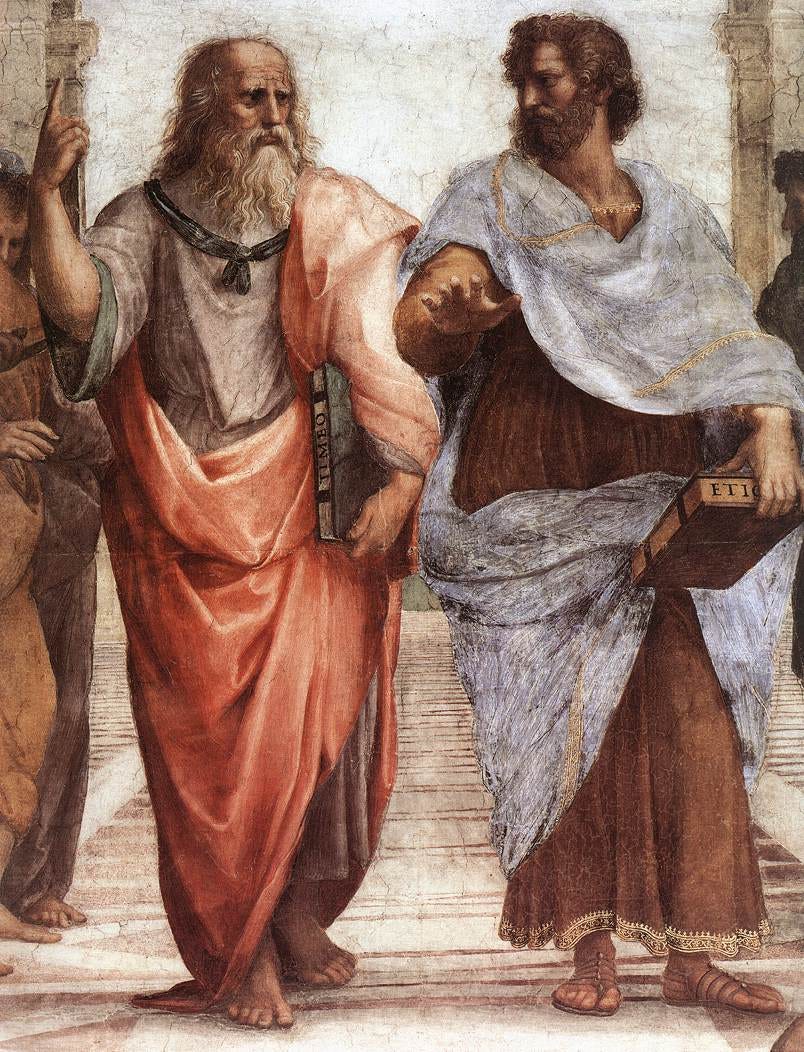
Intellectual virtues have a similar depth. Aristotle identified several: episteme (knowledge of facts), nous (intuitive understanding), and techne (craft knowledge, where we get the word “technology”). These are not merely skills to be deployed for any purpose. They are orientations of character.
And yet Aristotle insists that the two kinds of virtue, intellectual and moral, cannot be fully separated in practice. Phronesis requires the moral virtues to aim at genuinely good ends; and the moral virtues require phronesis to know how to achieve them. They are logically distinct but practically inseparable, each completing the other.
But the highest of the intellectual virtues is phronesis.
Phronesis: Metacognition with a Soul
Phronesis is often translated as “practical wisdom,” but that barely scratches the surface. Phronesis is the capacity to perceive what a situation actually requires and then to act accordingly. It integrates knowledge, judgment, and the moral virtues into a unified capacity for discernment.
In this sense, phronesis is the whole point and purpose of classical education: forming students who can see what’s really happening in the world around them and respond with what’s truly needed.
Here is what strikes me about the contrast with modern metacognition research. Contemporary educators ask: Am I reasoning well? Phronesis asks something deeper: Am I living well? Am I seeing what this situation genuinely requires of me?
Modern metacognition is a cognitive tool. Phronesis is a moral achievement.
The difference is not trivial. Skills can be deployed for any purpose including destructive ones. But virtues are always oriented toward the good. When we talk about forming students who think well, we should mean something closer to phronesis than to “critical thinking skills.”
Martin was right that these categories overlap. But critical thinking is a toolkit; phronesis is a character. Classical education aims at the latter.
The Trivium as Metacognitive Scaffold
One of the distinctive features of classical education is the Trivium: a centuries-old framework consisting of grammar, dialectic, and rhetoric. In the classical tradition these were stages of curricula, though in practice they spiral rather than stairstep. Dorothy Sayers, in her famous 1947 essay “The Lost Tools of Learning,” recognized that the Trivium also maps onto something we now understand developmentally.
What I want to suggest is that the Trivium is also a metacognitive scaffold. And a remarkably complete one.
In the grammar stage, students absorb the structure of knowledge: vocabulary, facts, forms, the raw material of thought. This is not passive reception. It is building the cognitive substrate that all higher thinking requires. Modern learning science validates what the ancients knew intuitively: you cannot reflect on what you do not know.
In the dialectic stage, students learn to interrogate what they know, to ask whether it holds up, whether it is internally consistent, what follows from it. This is externalized metacognitive monitoring. The student is no longer just acquiring knowledge; she is auditing it.
In the rhetoric stage, students learn to communicate what they know persuasively and clearly to others. This demands the deepest self-knowledge of all. You cannot explain something clearly unless you genuinely understand it. The attempt to articulate reveals the gaps.
Put these three stages together and you have something remarkable: a developmental arc that moves students from absorption to interrogation to expression. And at each stage, this arc makes visible what kind of thinking is being asked of them.
This is something any teacher can make explicit, even outside a classical school, even within a single unit. The sequence suggests a diagnostic question: Have I given students enough foundational knowledge before I ask them to analyze? Have I asked them to analyze before I ask them to present? If not, I may be asking them to reason with tools they don’t yet have.
The Socratic Method as Formation Practice
Most teachers have encountered the Socratic method in some form. Fewer have thought carefully about what it is actually doing cognitively.
A review in the American Journal of Pharmaceutical Education found that critical thinking and Socratic questioning are deeply intertwined. Critical thinking involves metacognition: the regulation of one’s own thinking. Socratic questioning provides a social structure for doing exactly that.
When a teacher asks, “I don’t quite follow; can you say more about that?” or “What would someone who disagreed with you say?” or simply “How do you know?”, something important happens. The teacher’s probing questions model the inner voice the student must eventually internalize. Over time, those prompts migrate inward. The student begins to ask herself the same questions, independently, habitually.
This is why Socratic discussion is not merely a technique. It is a formation practice. It builds the habit of self-interrogation, which is precisely what metacognition research identifies as the key to self-regulated learning.
A practical note: you do not need to run a full Socratic seminar to apply this. Even one genuinely probing follow-up question per discussion — “Why do you think that?” — begins to externalize the metacognitive process.
It’s also worth noting what this demands of the teacher. The Socratic method is not a day off. It requires the teacher to have done the intellectual work first — to know the subject deeply enough to ask questions that actually open up the problem rather than close it down. Classical teaching demands more of the teacher, not less.
Primary Sources and Epistemic Humility
The Great Books tradition is not simply about reading old things. It is about encountering minds that reasoned differently than we do and being forced to account for why.
When a student reads Plato and Aristotle side by side and discovers that they disagree, something important happens. The student cannot simply absorb one view as “the answer.” She must begin to adjudicate. That is a profound metacognitive exercise.
Modern learning scientists call this epistemic sophistication, the capacity to recognize that knowledge is constructed, fallible, and subject to revision, while still making genuine commitments. Primary sources develop this naturally, in ways that textbooks rarely do.
Consider the difference. Textbooks tend to present settled conclusions. Primary sources present arguments, performances of thinking, made by real people, for reasons, in contexts. The student who reads a textbook learns what to think. The student who reads primary sources learns that thinking is always an act someone performed, and that they must now perform it themselves.
For teachers outside classical schools, this does not require a full Great Books curriculum. Even one primary source per unit — one speech, one letter, one original document — begins to shift the epistemic culture of the classroom. A useful follow-up practice: ask students, “What did this person assume that we don’t? What did they know that we’ve forgotten? What did they get wrong that we can now see?” These questions are calibration exercises, which is to say, they are core metacognitive work.
What Modern Metacognition Is Missing
Everything I’ve described (phronesis, the Trivium, Socratic dialogue, primary sources) is not a random collection of old practices. It is a coherent, philosophically grounded approach to the question of how we teach students to think.
What modern metacognition research often misses is this: the classical tradition situates the question of how we learn within the question of what we are learning for. Phronesis is metacognition with a purpose. The Trivium is self-regulated learning with an anthropology behind it. The Socratic method is collaborative calibration in pursuit of truth, not merely accuracy.
Modern PD tends to offer strategies. The classical tradition offers a vision: education is not primarily about filling students with knowledge or equipping them with skills. It is about forming them — forming the kind of minds and characters capable of pursuing wisdom and living well.
Most teachers, if they are honest, believe that too.
Three Entry Points
If you want to explore this further in your own classroom, here are three things you can try immediately:
Ask one genuinely Socratic follow-up question per discussion. “Why do you think that?” “What would someone who disagreed say?” That’s it. Start there.
Introduce one primary source per unit. One speech, one letter, one original argument. Ask students what the author assumed, what they knew that we’ve forgotten, and what we can now see that they missed.
Name the stage of thinking you are asking students to engage in. “Today we’re going to interrogate what we learned last week — not just apply it.” Making the scaffold visible is itself a metacognitive act.
The classical tradition has been refining answers to these questions for twenty-five centuries. It turns out we haven’t had to start from scratch after all.
Related posts: