
Six-figure poverty?
The political class has abandoned the middle class

Updated, 12/1/25: When I shared the essay below on social media it generated a lot of comments, most of which were push-backs on the notion that $140,000 income is anything close to “poverty,” or challenging various parts of the argument that the American Dream is farther out of reach than it used to be. Today Tyler Cowen, also writing for the Free Press, offered this take-down of Michael Green’s original analysis. I agree with the critics (as I did in the essay below) that defining $140K as poor seems inaccurate and rhetorically unhelpful. But the larger point I wanted to make about Green’s piece is actually reinforced in Tyler Cowen’s rebuttal: while $140K isn’t poor, that doesn’t mean that affordability of the American Dream isn’t an issue we should be concerned about. A lot of college-educated professionals live in a cultural and economic bubble and don’t know the various ways in which working class families tend to struggle. Those struggles to feel financially secure are driving a lot of political anger, which is worthy of our attention, and practical solutions to the problems of housing, retirement savings, and affordable health and child care should be priorities.
Last week I wrote that the American Dream seems to be increasingly out of reach for ordinary people, and argued that the next winning political agenda - if there is to be one that avoids some radically leftist shift that threatens the very foundation of the Republic - will be the one that offers a realistic promise for its restoration.
Last week also saw a jaw-dropping article in The Free Press by financial analyst Michael W. Green, “The Valley of Death: Why $100,000 Is the New Poverty.” Green explains why, despite the fact that Millenials appear to make more money than their parents at the same age, the reality is that what used to be considered a middle class income is really a barely sustainable wage.
Green explains that the federal poverty line, established in the mid-1960’s, was and remains based on the minimum amount of money it took to feed a family with groceries (in 1963, adjusted now for inflation) times three (based on the idea that your food budget should take no more than about one-third of your income, the percentage that was common in the mid-1960’s). If your income was below minimum groceries times three, you were in financial danger. This made sense at the time. As Green explains:
Housing was relatively cheap. A family could rent a decent apartment or buy a home on a single income. Healthcare was provided by employers and cost relatively little (Blue Cross coverage cost in the range of $10 per month). Childcare didn’t really exist as a market—mothers stayed home, family helped, or neighbors (who likely had someone home) watched each others’ kids. Cars were affordable, if prone to breakdowns. College tuition could be covered with a summer job.
But now, the economy has vastly changed:
Housing costs exploded. Healthcare became the largest household expense for many families. Employer coverage shrank while deductibles grew. Childcare became a market, and that market became ruinously expensive. College went from affordable to crippling.
The labor model shifted. A second income became mandatory to maintain the standard of living that one income formerly provided. But a second income meant childcare became mandatory, which meant, for many, two cars became mandatory. The composition of household spending transformed completely. In 2024, food-at-home is no longer 33 percent of household spending. For most families, it’s 5 to 7 percent. Housing now consumes 35 to 45 percent. Healthcare takes 15 to 25 percent. Childcare, for families with young children, can eat 20 to 40 percent.
If you keep Orshansky’s logic [the economist who first formulated the federal poverty threshold]—if you maintain her principle that poverty could be defined by the inverse of food’s budget share—but update the food share to reflect today’s reality, the multiplier is no longer three.
It becomes 16. Which means if you measured income inadequacy today the way Orshansky measured it in 1963, the threshold for a family of four—the official poverty line in 2024—wouldn’t be $31,200. If the crisis threshold—the floor below which families cannot function—is honestly updated to current spending patterns, it lands at close to $140,000.
Meanwhile, median household income in the U.S. is actually around $80,000.
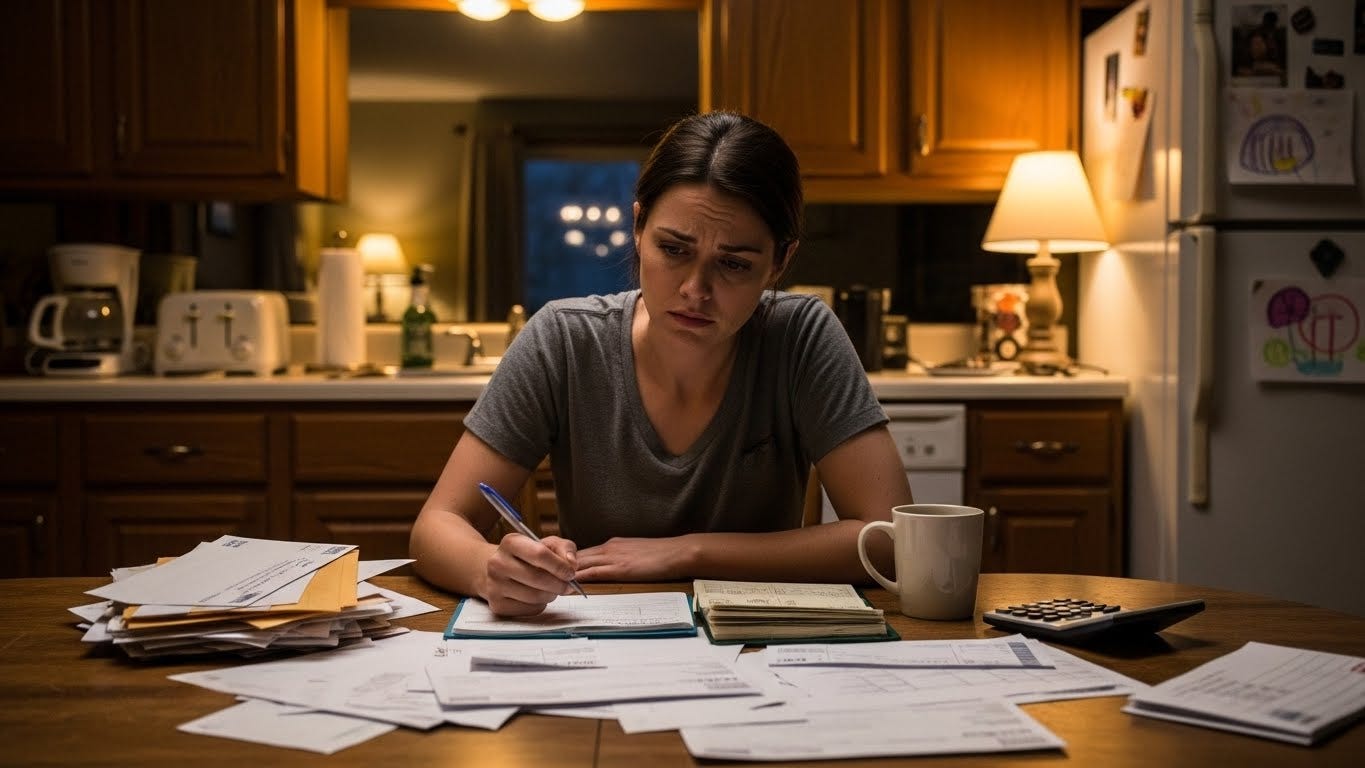
Green acknowledges that yes, of course, we enjoy a plethora of luxuries today that was unknown even two generations ago. But having these relative amenities in our life has not brought financial security to many Americans. And what is eating up our incomes is not luxury, but the simple price of participating in the economy: housing, health care, childcare.
Green brings it back to the loss of the American Dream:
The anger at the benefits given to the poor—the EBT card, healthcare, childcare subsidies—comes from seeing that people are getting for free the exact things that they are working 60 hours a week to barely afford. And these are just the bare costs of participation. The anger isn’t about the goods. It’s about the breach of contract. The American Deal was that effort = security. Effort brought your hope strike closer. But because the real poverty line is $140,000, effort no longer yields security or progress; it brings risk, exhaustion, and debt.
Read the entire essay. Green doesn’t cite many sources, and I’m not an economist so I am not able to critique his numbers, but his analysis explains so much of the populist energy that has driven MAGA on the right and the Mamdani-Maoists on the left. Economist Jeremy Horpedahl offered some criticism of Green’s article, arguing that median income figures are misleading and that typical incomes for families of four with two earners are much more commonly near the $140,000 or higher mark.
Horpedhal may be right that it’s misleading to describe $140,000 per year as poor in many parts of the country, but his criticisms don’t convince me that such an income gives a family meaningful access to the American Dream as I described it in my own recent essay. A family of four may well be able to afford rent in many parts of the country, as Horpedahl argues, but renting and owning are not the same things. Nor does it mean that you can save sufficiently for retirement or be safe from medical bankruptcy.
Meanwhile, American Enterprise Institute Senior Fellow Ruy Teixeira, who co-founded the consistently readable Substack Liberal Patriot, made an additional contribution to this discussion this week. Teixeira’s raison d’etre seems to be explaining to Democrats why they are losers. He’s done it a million ways, and this week he argued that “The Left’s 21st Century Project Has Failed” for four main reasons:
The left’s embrace of open borders has propped up an otherwise unsustainable economy and artificially depressed working class wages
The left’s obsession with climate change politics and cultural radicalism have alienated working class voters and abandoned their economic needs
The left’s techno-pessimism has undermined the economic growth that is ultimately the only engine for a vibrant middle class
Understand that Teixeira is writing as a man of the left. He’s not offering a politically conservative critique of progressivism. He’s arguing that the left has committed political hara-kiri because of its commitments to elitist luxury beliefs that hurt the working class.
I don’t have any confidence that the progressive leftists who run the Democratic Party will actually heed Teixeira’s advice and repent of their anti-working-people agenda. That just leaves the Republicans, and while President Trump seems to have tapped into the populist spirit of the moment, and Vice President J.D. Vance seems to understanding intuitively where the American Dream went off the rails, it’s unclear still that the GOP will articulate a long-term, sustainable agenda focused on the restoration of the middle class.
I think this is largely because the Republicans, like the Democrats, do not have a meaningful theory of the human person upon which to rest a sustainable political and economic vision. Liberalism, which infects the American right and left alike, rests on the assumption that the “free” individual, who chooses his or her (or “their” or “zir”) own meaning of life, is the fundamental unit of society, and for whose benefit the political economy exists.
What is needed instead is a system of economic and political thinking that knows why we want to create a vibrant middle class, why we want a vibrant economy where effort can bring reward, why we want peace and order in our communities, why we want a fairly large degree of personal freedom.
Catholic social teaching provides the answer to these why questions, not with the sterile and nihilistic answer of modernism (to maximize our consumer capacity or to “define one’s own concept of existience”) but rather with a specific, Christian vision of “the good life:” one in which freedom means liberation both from the selfish desires that undermine our good and the good of others, and the political and economic barriers that inhibit our capacity to live out our personal vocations as God desires.
I explored Catholic social teaching at length in this recent post. Let me just conclude for now by saying again that the restoration of the middle class in the U.S. and Europe is not simply a good political strategy or a question of effective economic policy. It is a key component to the revival of a specifically Judeo-Christian understanding of the common good, one whose decline has precipitated not just harder economic times, but the general crisis of meaning plaguing modern society.
May we seek new strategies based on a timeless vision of the common good.
Related posts:
Phenomenal read